
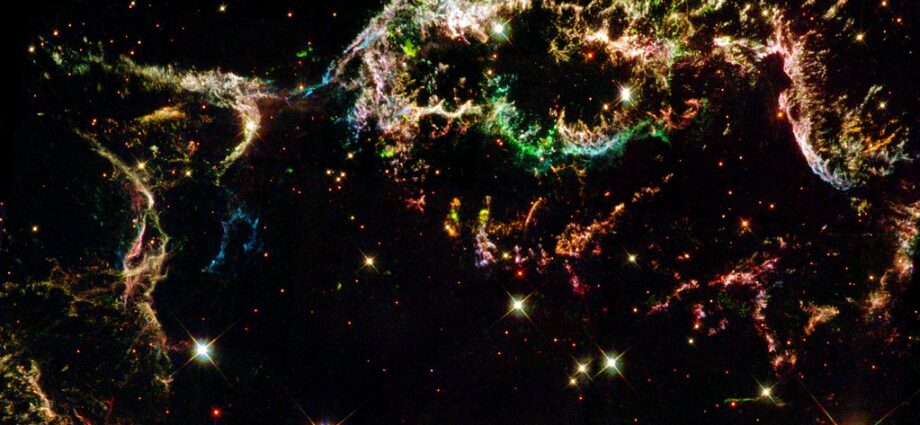
Cas A supernova has provided proven evidence that a star’s layers may have merged just hours before the explosion. This discovery sheds light on the processes leading to supernova events.
Understanding Cas A Supernova
The Cas A supernova, known for its remnants located in the constellation Cassiopeia, has recently gained attention due to new findings from the James Webb Space Telescope. Researchers have discovered compelling evidence suggesting that the layers of the star may have merged shortly before the supernova event occurred. This phenomenon, which has puzzled astronomers for years, indicates that complex interactions took place in the final moments of the star’s life.
Scientists believe that this merging could significantly influence the characteristics of the supernova explosion. The findings challenge previous assumptions about the processes leading to such stellar phenomena. As researchers delve deeper into the data gathered from the Webb telescope, they hope to unravel more mysteries surrounding the Cas A supernova and its implications for our understanding of stellar evolution.
- Location: Constellation Cassiopeia
- Key Finding: Layer merging before explosion
- Impact: Challenges existing theories
What Causes Supernova Explosions?
Supernova explosions are among the most powerful events in the universe, resulting from the catastrophic end of a star’s life cycle. The primary causes of these explosions can vary, but they often involve the following processes:
- Core Collapse: When a massive star exhausts its nuclear fuel, its core collapses under gravity, leading to a supernova.
- White Dwarf Accretion: In binary systems, a white dwarf can accumulate matter from a companion star until it reaches a critical mass, resulting in a thermonuclear explosion.
- Layer Merging: Recent findings related to the Cas A supernova suggest that the merging of a star’s layers just hours before its explosion may also contribute to the dynamics of supernova events.
These mechanisms highlight the complex processes that govern the life and death of stars, shedding light on phenomena such as the Cas A supernova.
Cas A Supernova and Star Layers
The Cas A supernova, which occurred approximately 350 years ago, has provided astronomers with invaluable insights into the life cycle of massive stars. Recent findings from the James Webb Space Telescope suggest that the layers of the star may have merged just hours before the explosion, challenging previous theories about supernova mechanics.
This merging process could have significant implications for our understanding of how massive stars evolve and ultimately explode. Key points from the findings include:
- Layer Composition: The merging layers were likely composed of different elements, contributing to the complexity of the explosion.
- Timing: The proximity of the merger to the supernova event raises questions about the processes leading to such dramatic cosmic occurrences.
- Future Research: Ongoing studies will focus on unraveling the effects of this merging phenomenon on the observed remnants of Cas A.
This groundbreaking evidence not only enhances our understanding of Cas A supernova but also paves the way for future explorations into stellar evolution.
Recent Discoveries in Astronomy
Recent discoveries in astronomy have shed new light on the Cas A supernova, revealing intriguing details about the events leading up to this monumental explosion. Astronomers using the Webb Space Telescope have found strong evidence suggesting that the layers of the star may have merged just hours before the supernova occurred. This finding challenges previous theories regarding the death of massive stars and adds a new dimension to our understanding of stellar evolution.
Key aspects of this discovery include:
- Layer Merging: The merging of the star’s layers may have contributed to the explosive energy released during the Cas A supernova.
- Implications for Stellar Models: This evidence necessitates a reevaluation of current models used to predict supernova behavior.
- Technological Advancements: The capabilities of the Webb Space Telescope have opened new avenues for research in astrophysics.
As scientists continue to analyze the data, the implications of the Cas A supernova may reshape our understanding of the life cycles of stars.
The Role of the Webb Telescope
The James Webb Space Telescope has significantly advanced our understanding of the Cas A supernova by providing groundbreaking evidence regarding the merging of stellar layers. This phenomenon occurred mere hours before the supernova’s explosion, offering new insights into the complex processes leading to such cosmic events.
According to researchers, the Webb Telescope’s advanced imaging capabilities allowed them to analyze the composition and structure of the star prior to its demise. The findings suggest that the outer layers of the star may have interacted with its core in unexpected ways.
Key points from the study include:
- Layer Interaction: Evidence of merging layers challenges previous models of supernova explosions.
- Impact on Supernova Mechanics: Understanding these interactions can help refine theories on how stars end their life cycles.
- Future Research: Further observations with the Webb Telescope will continue to unravel the mysteries of Cas A supernova.
These revelations underscore the role of modern technology in unlocking the secrets of the universe.
Future of Supernova Research
The future of supernova research holds exciting potential, especially in light of the recent findings regarding the Cas A supernova. As astronomers continue to analyze data from advanced telescopes like the Webb, new insights into the mechanisms behind supernova explosions are emerging. Researchers are particularly focused on the implications of star layer merging, which may have occurred just hours before the Cas A event.
This groundbreaking evidence opens up numerous avenues for exploration:
- Enhanced Understanding: Scientists expect to refine models of stellar evolution and explosion mechanisms.
- Targeted Observations: Future telescopes may focus on specific star types that are likely to undergo similar processes.
- Interdisciplinary Collaboration: Increased collaboration between astronomers and physicists could yield new theories in stellar dynamics.
As research continues, the Cas A supernova will likely remain at the forefront of astronomical studies, shaping our understanding of the universe.
By Hubble Heritage via Openverse
Comments are closed, but trackbacks and pingbacks are open.